-
Casters
▾
-
Light Duty Casters Up to 350 Lbs
-
Medium Duty Casters Up to 1,500 Lbs
-
Heavy Duty Casters Up to 40,000 Lbs
-

Track Casters
-
Stem Casters All Stem Types
-
Stainless Steel
-
Pneumatic Casters Ait & Flat Free
-
Furniture Casters All Styles
-
High Temp Casters Up to 550 ˚F
-
Metric Casters
-

Leveling Casters
-
Spring Loaded
-
- Wheels ▾
- By Application ▾
- Accessories & Parts ▾
- Material Handling Products ▾
- Volume / Resale


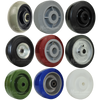


















Wheels & Bearings

A caster is composed of 4 major components: the wheel, rig, axle, and nut. To learn more about the wheel and rig, see our other articles:
Just like the rig, the wheel plays a major role. Picking the right wheel is essential to how much effort it will take to move, the amount of weight it can carry, and its overall longevity.
Caster Wheels
Soft or Hard Wheels?
The hardness (or softness) of a wheel is dependent on the type of floors the wheels will be rolling on, the capacity they will need to carry, and how often they will move.
Soft wheels are great on rough floors, able to flatten out and roll easier over debris and cracks. However, the softer material also means the wheel will have a lower capacity and are more likely to flat spot.

Hard wheels are ideal for smooth floors, and have a harder time rolling on rough surfaces. They are able to carry higher capacities, and often last longer in use. Remember that hard wheels are also more likely to cause damage to the floor.

Wheel Dimensions
As a rule of thumb, the larger the wheel's diameter, the easier it is to move. This is helpful when rolling over rough surfaces or small debris. Diameter is also related to capacity - a larger wheel can carry more capacity.

The width of a caster wheel is another big determinant of capacity. The wider the wheel, the more weight it can bear. We recommend a wider wheel (if the rig's forks allow it) for the sake of higher capacity - it's better to have more than you need than not enough!

Bearings

Between the wheel and the axle can be a bearing or bushing, which assist in moving the wheel and make rolling the caster easier and smoother.
There isn't room for bearings or bushings on every wheel - plain bore wheels rest directly on the wheel - but many wheels will have a larger bore to accommodate the bearing or bushing fitting on the axle.
When deciding to go with a bearing, bushing, or neither, consider the following:
- Will the wheel be in a wet environment? Rust can be a real problem. Stainless steel bearings will help combat rust and last longer. Delrin bushings are made of composite materials that don't rust.
- Will the wheel be in a very hot environment? The bearings and bushings need to be rated to work in high temperatures without melting. Steel bearings, or brass bushings or bronze bushings will do the job.
If not used in wet or hot environments, any bearing option can be used, suited to your budget and preferences.
To learn more about bearings and bushings, go here for an in-depth look. This article only scratches the surface!
Quick Guide for Wheel Selection
There are quite a lot of wheels to choose from in the caster world, and it's very easy to get confused or overwhelmed. Below is a quick guide with the major characteristics you should consider when purchasing a wheel, and the wheel materials which have those properties:
 |
Floor Protective |
|
 |
Non-Marking |
|
 |
Chemical Resistant |
|
 |
Great for Water |
|
 |
Harsh on Floors |
|
 |
Soft-Treaded |
|
 |
May Flat Spot |
|
 |
Hard-Treaded |
|
Final Thoughts
When it comes to picking out a caster wheel, consider the floors it will be rolling on and environment it will be working in. Consider the diameter of the wheel and whether it will assist you or restrict you. Consider the amount of weight bearing down on the wheel.
Need some help prioritizing different characteristics? Not sure which bearing option to go with? Contact us or give us a call at 800-345-0425 (Mon-Fri 7AM - 4:30 PM). We are more than happy to help you out with your project!
Also in Caster Knowledge

Measuring Threaded Stem Casters
Threaded stem casters can be difficult to measure. Learn how to measure stem diameter, length, and thread pitch for an exact replacement fit.

High Temp Dual Wheel Casters
Discover high-performance dual wheel casters built for low clearances, heavy loads, and extreme temperatures up to 425°F, with excellent rolling and swiveling performance.

CG-MAX Green Poly on Aluminum Caster Wheels
"No Compromise" Casters & Wheels: Discover how wheel diameter, tread shape, bearings, and floor conditions affect rolling performance, and why CG-MAX polyurethane on aluminum wheels deliver efficient, durable performance.


