-
Casters
▾
-
Light Duty Casters Up to 350 Lbs
-
Medium Duty Casters Up to 1,500 Lbs
-
Heavy Duty Casters Up to 40,000 Lbs
-

Track Casters
-
Stem Casters All Stem Types
-
Stainless Steel
-
Pneumatic Casters Ait & Flat Free
-
Furniture Casters All Styles
-
High Temp Casters Up to 550 ˚F
-
Metric Casters
-

Leveling Casters
-
Spring Loaded
-
- Wheels ▾
- By Application ▾
- Accessories & Parts ▾
- Material Handling Products ▾
- Volume / Resale


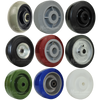



















Casters and Sockets

If you've ever used an office chair, you may have noticed the casters on the bottom that allow you to roll around. There's a good chance too that you're using that same chair right now.
With all that rolling around, over wires, cords, and other office equipment, it's a surprise those casters haven't fallen off the chair! Speaking of which, why haven't they?
The answer could be that your office chair has sockets in them. The sockets grip the neck of the caster and hold it in place, allowing you to keep sitting and rolling around in the chair.
To ensure the best performance for your application, the caster and socket you select need to be exactly right. In this article, we'll go over some steps to make your choice, breaking down the selection and installation process into 5 steps.
Step 1: Picking a caster
A caster uses a socket to be attached to an object, so the first thing to select is the appropriate caster for your needs.
For those looking for heavy-duty casters, casters that use sockets are not ideal due to their lower capacity. Instead, look into using that have a threaded stem or that utilize a plate.
Casters that use sockets are geared towards less stressful applications and are more economical, and have two different types: Grip Neck or Grip Ring.
- Grip neck casters have less options, but feature a smaller profile stem, which works better for smaller surface areas like a table leg.
- Grip ring casters have more options and variations but are larger, limiting their usage in tighter, more compact spaces.

Step 2: Measuring the ID
Once you've selected a caster, you need to measure the internal diameter (ID) of the hole of the object you're attaching the caster to. This allows you to find a socket that fits.
For the most precise measurements, use a caliper, though any other measuring tool would do.

Step 3: Selecting a socket
After finding the ID of the hole, you can find the appropriate socket.
In an ideal situation, the socket would fit snugly, fitting exactly inside the hole, but this is not always necessary. If there is no suitable socket of a perfect fit, we recommend getting a larger-sized socket and sanding it down to size.

Another factor to consider is the socket's material: plastic or metal.
Plastic sockets are cheaper, easier to remove if needed, but are also prone to loosen over time with extended use. Metal sockets are more expensive and harder to remove, but are better for consistent use, holding up better to wear and tear. Metal sockets also need to sit flush at the end of the tubing, which requires you to measure the outside of the tubing.


Step 4: Installing socket
Once you've gathered the socket and caster, it's time to put everything together.
Hand press the socket into the hole first. If more force is needed, use a mallet, not a hammer, to avoid damaging the socket.

Step 5: Installing the caster
Finally, hand press the caster into the socket, as using a hammer or even a mallet could damage the caster.
Apply enough pressure to insert the caster into the socket until the stem is no longer visible and the socket and swivel section have made contact. Gently tug or shake the caster to ensure it's properly attached to the socket.

Final Thoughts
With the abuse casters can take on a daily basis, it's important to consider the sockets that help keep them in place. They're a simple, yet crucial part to a caster's overall rigidity and making sure you've selected the right one for your needs goes a long way in ensuring smooth operation.
If you have any questions or need further assistance, feel free to contact us or give us a call at 800-345-0425 (Mon-Fri 7:00am - 4:30pm CST).
Also in Caster Knowledge

Measuring Threaded Stem Casters
Threaded stem casters can be difficult to measure. Learn how to measure stem diameter, length, and thread pitch for an exact replacement fit.

High Temp Dual Wheel Casters
Discover high-performance dual wheel casters built for low clearances, heavy loads, and extreme temperatures up to 425°F, with excellent rolling and swiveling performance.

CG-MAX Green Poly on Aluminum Caster Wheels
"No Compromise" Casters & Wheels: Discover how wheel diameter, tread shape, bearings, and floor conditions affect rolling performance, and why CG-MAX polyurethane on aluminum wheels deliver efficient, durable performance.


