
-
Casters
▾
-
Light Duty Casters Up to 350 Lbs
-
Medium Duty Casters Up to 1,500 Lbs
-
Heavy Duty Casters Up to 40,000 Lbs
-
Track Casters
-
Stem Casters All Stem Types
-
Stainless Steel
-
Pneumatic Casters Ait & Flat Free
-
Furniture Casters All Styles
-
High Temp Casters Up to 550 ˚F
-
Metric Casters
-
Leveling Casters
-
Spring Loaded
-
- Wheels ▾
- By Application ▾
- Accessories & Parts ▾
- Material Handling Products ▾
- Volume / Resale


















Polished Concrete and Wheel Staining

Polished concrete is one of the most popular floors around. It's tough, it's easy to clean, and it looks great in offices, shops, restaurants, and homes. But many owners get an unpleasant surprise a few months in: brownish or dark spots right where a cart, chair, or rolling rack has been sitting.
Those marks usually aren't dirt, and they rarely mop away. In most cases, they come from the wheels themselves. Here's what's happening and how to avoid it.
What causes the marks?
Many soft wheels, including rubber and thermoplastic rubber (TPR), contain ingredients called plasticizers. Plasticizers are what make the wheel soft, grippy, and quiet.
The catch is that plasticizers don't always stay put. When a soft wheel presses against a floor for a long time, some of those ingredients can slowly seep out of the wheel and into the floor's protective finish. The result is a stain shaped like the wheel's footprint. The industry calls this plasticizer migration, and it's the same reason car tires sometimes leave marks on sealed garage floors.

A few things make it worse:
- Time. A cart parked in the same spot for weeks is far more likely to stain than one that moves daily.
- Heat Warm rooms and sunny spots speed things up.
- Weight. Heavier loads press the wheel harder into the floor.
One common point of confusion: a wheel labeled "non-marking" won't leave black scuffs when it rolls. That doesn't mean it won't stain when it sits. Those are two different problems.
Which floors are most at risk?
It depends on what's on top of the concrete. Most polished floors are finished with some kind of protective product, and those products react to soft wheels differently.
| Floor finish | What it is | Staining risk from soft wheels |
|---|---|---|
| Acrylic sealer / cure-and-seal | A clear coating that sits on the surface | Highest; this is where wheel and tire staining is most often reported |
| Polymer "guard" / burnished finish | A thin protective layer applied after polishing for shine and spill resistance | Higher; it's a soft polymer layer, much like a sealer |
| Penetrating stain protector | Soaks into the concrete instead of forming a film | Lower |
| Dense urethane / epoxy coating | A thick, hard, highly cross-linked coating | Lower; denser films resist plasticizers |
| Bare densified polish with no topcoat | Polished concrete with nothing on top | Lower; however, pores can still absorb oils |
Here's the tricky part:most commercial polished floors have a guard or sealer on them, and many owners don't know which one. If you're not sure, ask the contractor who installed or maintains the floor.
The best choice: polyurethane wheels
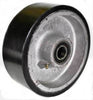
For most polished concrete floors, polyurethane wheels are the safest bet. They give you much of what people like about rubber, like a quiet, smooth ride and some cushion, without the plasticizers that cause staining. They also carry heavier loads and hold their shape better than rubber.

| Wheel Type | Staining Risk | Noise | Ride / Feel | Best For |
|---|---|---|---|---|
| Polyurethane | Low | Quiet | Smooth, slight cushion | Most polished floors; carts, chairs, racks, equipment |
| Thermoplastic Rubber (TPR) | Higher on sealed or guarded floors | Very quiet | Softest, most cushioned | Floors with no topcoat, or TPR that is labeled "non-staining" |
| Rubber | Higher | Quiet | Soft | Rough or outdoor surfaces, not polished floors |
| Nylon / phenolic | Low | Loud | Hard; rolls very easily | Heavy industrial loads where noise doesn't matter |
Simple ways to protect your floor
- Choose polyurethane wheels for anything that rolls or parks on polished concrete.
- Keep things moving. Avoid leaving carts, racks, or heavy equipment parked in one spot for weeks at a time.
- Watch the hot spots. Be extra careful near windows, heaters, and other warm areas.
- Think beyond wheels. Rubber-backed mats and rugs, rubber feet on furniture, and even some vacuum wheels can cause the same staining.
- Test first. Before outfitting a whole fleet, park one wheel in an out-of-sight spot for a few weeks and check for marks.
- Ask your floor installer. Find out what guard or sealer is on your floor. Some product makers list which wheel materials to avoid.
Already have marks?
Start with the gentlest fix. Light discoloration can sometimes be cleaned up with a concrete degreaser. If the stain has soaked deep into the guard or sealer, the finish in that area may need to be stripped and reapplied by a floor professional. Then switch to polyurethane wheels so it doesn't come back.
Final Thoughts
Soft rubber and TPR wheels feel great, but on most polished concrete floors they can leave stains that are hard to undo. Polyurethane wheels give you a quiet, smooth roll without the risk. A small change in wheel choice can protect a big investment in your floor.
Not sure which wheel is right for your floor? Contact our team and we'll help you find the right fit. Call us at 800-345-0425 (Mon-Fri 7:00am-4:30pm CST) or contact us on our website.
Also in Caster Knowledge

Kitchen Casters: Caster Rigs
Commercial kitchen casters face heat, grease, chemicals, and washdowns. Learn how stainless steel rigs, seals, and dust covers improve caster durability

Measuring Threaded Stem Casters
Threaded stem casters can be difficult to measure. Learn how to measure stem diameter, length, and thread pitch for an exact replacement fit.

High Temp Dual Wheel Casters
Discover high-performance dual wheel casters built for low clearances, heavy loads, and extreme temperatures up to 425°F, with excellent rolling and swiveling performance.


