
















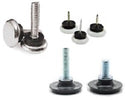




Installing Threaded Stem Casters

While plate casters are often the most secure way to mount your casters, they do require more room to mount. Caster mounting plates can differ in size, but are all several inches in width and height. This can be an issue in some situations, such as when attaching a caster to the leg of a chair or inside tubing.
When you don't have enough space for a plate, you can use stem casters. With only one attachment point, they are less sturdy and less sturdily attached, but allow you to attach a caster where you otherwise couldn't.
Stem casters come in two attachment styles: gripping or threaded. Grip ring or grip neck stem casters are only suitable for lighter-duty applications, and can be installed and replaced more easily (read our article on grip ring and grip neck stem casters here).
Threaded stem casters offer a great solution to both these problems: they are able to attach with minimal space, and can handle higher capacities.
Required tools
Caster Wrench

If you are mounting several casters and want the best attachment, you can use a caster wrench. Specially designed to hold or turn the swivel section of a threaded stem caster when you can't hold it from underneath. Casters that require a caster wrench will have an octagonal swivel section.
Wrench

Some casters have a bolt head underneath the swivel section that can be used with a regular wrench. Using this bolt, the swivel section can be turned or held and allow you to thread the stem or secure the nut easily.
Ratchet and Socket

A ratchet and socket are useful for turning the nut on top of the stem when installing or replacing the caster. A regular or crescent wrench can also be used.
Fastening Methods
Nuts and Washers

The easiest way to attach a caster to your item is using a plain nut and split washer. This combination allows the caster to be easily removed or tightened with hand tools.
A serrated or lock nut can also be used, but lock nuts require more effort and force to fully tighten or loosen.
T-Nut

A t-nut can be installed in wooden items, hammered into a pre-drilled hole.
To keep the t-nut from rotating in place, the insert can have teeth on its edge (a pretty good attachment), or can have holes to allow you to screw the nut in (a better attachment).
Hollow Tubing Threaded Inserts

Hollow tubing inserts are made in common circular or square tubing sizes, and the threading on the inside allow you to attach the caster where empty space would be.
The inserts use a spring clip to keep from backing or coming out. To install the insert, use a mallet to tap the insert in, or thread a regular bolt into the insert and tap on the bolt. These inserts tend to be difficult to remove once installed.
Installing Your Stem Caster Correctly

To get the best performance from your caster, installing it correctly is imperative.
A correctly installed stem caster is mounted flush against the bottom of the item, with none of the stem visible between the mounting surface and the flat edge of the swivel section. Exposed stem runs the risk of bending under the weight or strain of use.
The stem is for attaching the caster, not to bear weight or level the item. If needing to adjust the height of an item using casters, leveling casters (found on our sister site here) can be adjusted to be at different heights and hold sensitive equipment level. With regular stem casters, the only part of the caster which should bear weight is the round or octagonal flat swiveling section.
Where the casters should be attached on the item depends on the project. Usually, casters should be placed on the corners of the object, but some projects require hidden or recessed casters, or additional casters along an edge. For advice on where your casters should be placed, feel free to contact our team!
Final Thoughts
Threaded stem casters bridge the gap for projects that cannot accommodate a plate caster but that need higher capacity than grip neck or grip stem casters. The thick threaded stem allows you to attach the caster firmly to the object.
Not sure if a threaded stem caster is what you need? Need help with your next project or installation? Feel free to contact us or give us a call at 800-345-0425 (Mon-Fri 7:00 AM - 4:30 PM CST) for advice!
Also in Caster Knowledge

Kitchen Casters: Caster Wheels
Learn how to choose the best commercial kitchen caster wheels by comparing heat resistance, floor protection, chemical resistance, and rolling performance.

Polished Concrete and Wheel Staining
Why some wheels stain polished concrete, and how to choose ones that won't. The wrong caster wheels can leave permanent brown marks on a polished concrete floor. The fix is simple: choose the right wheel material from the start.

Kitchen Casters: Caster Rigs
Commercial kitchen casters face heat, grease, chemicals, and washdowns. Learn how stainless steel rigs, seals, and dust covers improve caster durability


