-
Casters
▾
-
Light Duty Casters Up to 350 Lbs
-
Medium Duty Casters Up to 1,500 Lbs
-
Heavy Duty Casters Up to 40,000 Lbs
-

Track Casters
-
Stem Casters All Stem Types
-
Stainless Steel
-
Pneumatic Casters Ait & Flat Free
-
Furniture Casters All Styles
-
High Temp Casters Up to 550 ˚F
-
Metric Casters
-

Leveling Casters
-
Spring Loaded
-
- Wheels ▾
- By Application ▾
- Accessories & Parts ▾
- Material Handling Products ▾
- Volume / Resale




















Types of Caster Brakes

Caster brakes are often overlooked until equipment starts moving when it shouldn’t. Uncontrolled movement can lead to safety hazards, damaged equipment, or workflow interruptions.
All brake types have their advantages and use cases, so this guide can help elucidate which one is right for your application!
Two Major Categories of Brakes
Not all caster brakes work the same: they use different mechanisms to apply friction to the wheel. To simplify things, we can break (ha!) them into two different categories:
- Brakes that lock only the wheel
- Brakes that lock the wheel and the swivel
Wheel-Only Brakes
There are several ways to stop just the wheel from rolling, locking the wheel in one place.
Face Contact Brake
Face Contact brakes (FCB) provide the most recognizable style of brake. A pedal on the front or back of the caster presses a brake pad directly against the face of the wheel.
FCB's are a very convenient style of brake, but they require extra space for the pedal to poke out, do not work with every wheel, and are susceptible to high heat with their plastic pedal.

Top Lock Brake
A Top Lock brake (TLB) can be recognized by its side-operated pedal which presses a brake pad onto the top of the wheel. TLB's are also commonly called side-lock brakes, because their pedal is on the side of the caster.

Cam Lock Brake
Cam Lock brakes are less common, and are often confused with a TLB because the pedal is also on the side. This brake uses a rotating cam mechanism that wedges the side of the wheel against the rig to prevent rotation. Cam Locks are more often offered on smaller, cheaper casters.

Wheel & Swivel Brakes
Total Lock Brake
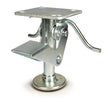
Total Lock brakes (SWB) are designed ONLY for swivel casters. SWB's lock both the wheel and the swivel section in place, preventing the caster from rolling or pivoting. This provides maximum stability when equipment must stay completely still.

Other Brakes
Besides the brakes mentioned above, there are a few other niche caster brakes. These niche brakes are far less common, and tend to be application-specific.
Some examples of niche brakes are:
- Set Screw brake
- Pin Lock brake
- Pressure-Activated brake
- Dead Man's brake
Which Wheel Brake Do I Pick?
When you have narrowed your brake choice down to a wheel-only lock, there isn't a single clear winner. Like with many things in the caster world, it depends on the application and environment where the caster will be used. All of the brake types perform similarly in stopping wheel rotation.
The decision typically comes down to preference, engagement style, or cost. If maximum stability is the goal, a Total Lock brake (SWB) on a swivel caster is the best option.
On Wheel Selection
Wheel selection plays a major role in how effective your brake will be.
Most brake pads are either steel or rubber. Steel brake pads tend to perform better on softer wheels because they can slightly bite into the tread for added grip. However, steel brake pads against harder wheels can increase the risk of slipping due to low friction.
Rubber brake pads provide better overall to grip to all types of wheels, but they're less common and they're not suitable for high-temperature applications.
Final Thoughts
Choosing the right brake caster starts with understanding how you’ll use your caster. How much movement and stability is okay when the brakes are engaged? How much room for brake pedals do you have? What kind of wheels are you considering? The right wheel and brake combination can make all the difference.
Need help deciding on a brake? Not able to find the combination you want? Give us a call at 800-345-0425 or contact us and have our caster experts walk you through it!
Light Duty Casters
Medium Duty Casters
Heavy Duty Casters
Threaded Stem Casters
Also in Caster Knowledge

Kitchen Casters: Caster Rigs
Commercial kitchen casters face heat, grease, chemicals, and washdowns. Learn how stainless steel rigs, seals, and dust covers improve caster durability

Measuring Threaded Stem Casters
Threaded stem casters can be difficult to measure. Learn how to measure stem diameter, length, and thread pitch for an exact replacement fit.

High Temp Dual Wheel Casters
Discover high-performance dual wheel casters built for low clearances, heavy loads, and extreme temperatures up to 425°F, with excellent rolling and swiveling performance.


